
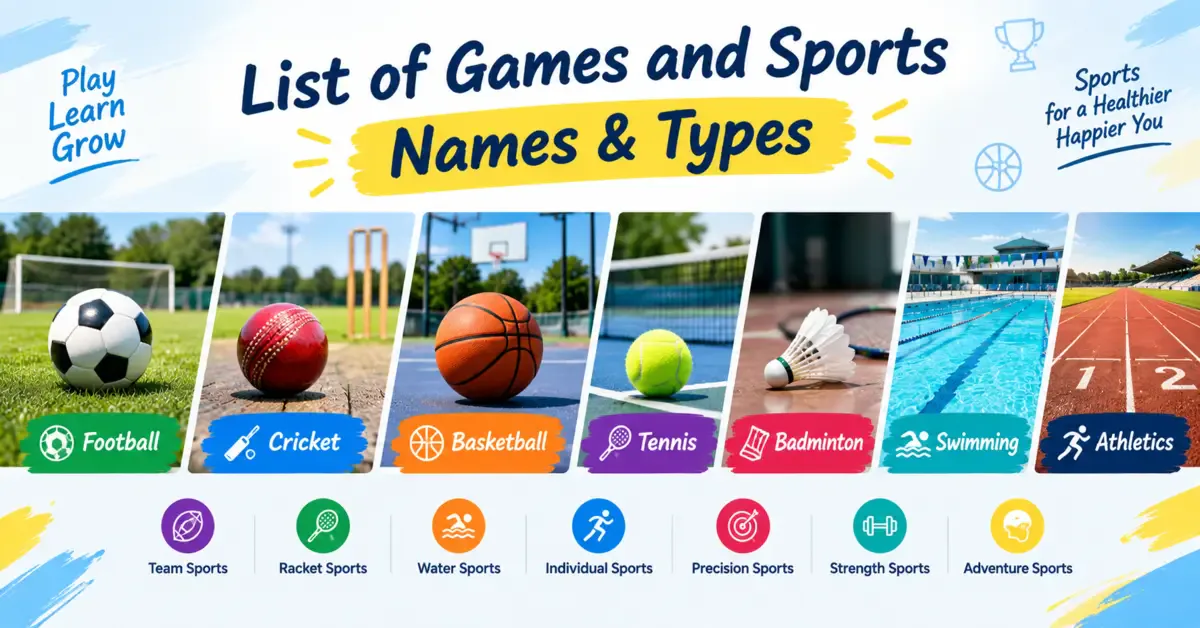
A list of games and sports includes familiar choices such as cricket, football, badminton and swimming, alongside traditional games, martial arts and specialist activities. This guide groups sports and games names by how they’re played, explains the categories, and helps you decide what to explore next.
You don’t need to memorize every name. Use the list to discover an activity, understand what it involves and find a realistic way to try it near you.
What’s the Difference Between a Game and a Sport?
A game is a rule-based activity that can involve physical movement, strategy, chance or a combination. A sport usually involves organised competition and skill, often with physical exertion. The terms overlap: cricket is both a game and a sport, while chess is a board game commonly described as a mind sport.
There’s also a difference between a sport, a discipline and an event. The Olympic explanation uses skiing as the sport, Alpine skiing as a discipline and giant slalom as an event. Listing every discipline separately can make an “all sports name list” appear larger without adding entirely different sports.
Sport Category List: Names of Different Sports
The groups below are practical reading categories, not an official worldwide classification. A sport can fit several groups: badminton is a racket sport, usually played indoors, and has singles and doubles formats.
1. Team Sports List
Team sports involve players working together toward a shared result. Examples include:
-
Cricket, Baseball and Softball: Bat-and-Ball sports involving batting, fielding and scoring runs.
-
Football, Futsal and Field Hockey: Games built around moving a ball into an opposing goal, using different rules and equipment.
-
Basketball and Netball: Sports where teams score through an elevated hoop.
-
Volleyball and Beach Volleyball: Teams send a ball over a net and defend their side.
-
Handball, Rugby Union, Rugby League and Lacrosse: Further team games with distinct passing, scoring and contact rules.
-
Kabaddi, Kho-Kho and Water Polo: Team sports played in very different settings, from courts and grounds to swimming pools.
Team size depends on the sport and format. Five-a-side football and full-size football aren’t interchangeable, so confirm what a local session actually offers. If you need players rather than lessons, read our guide to joining a weekend football group without a team.
2. Racket and Paddle Sports
Badminton, tennis, table tennis, squash, racquetball, padel and pickleball belong in this group. Players use rackets or paddles to strike a ball or shuttlecock. Some games use a net; others use court walls.
Badminton uses a shuttlecock, while tennis and table tennis use different balls and playing surfaces. Squash involves striking the ball against a front wall. Similar-looking equipment doesn’t mean the rules or courts are the same.
For beginners, check whether instruction, equipment hire and a playing partner are included. Booking a court alone doesn’t necessarily give you someone to play with.
3. Athletics, Gymnastics and Strength Sports
Athletics covers running, jumping, throwing and race walking. Names you’ll encounter include sprints, hurdles, middle-distance running, long-distance running, cross-country, marathon, long jump, high jump, triple jump, pole vault, shot put, discus, hammer and javelin. These aren’t all separate sports; many are disciplines or events within athletics.
Gymnastics includes artistic gymnastics, rhythmic gymnastics and trampoline gymnastics. Weightlifting and powerlifting are strength sports with different competition rules.
A school sports day might combine running races and jumping events. An athletics club may specialise in a smaller selection, so ask what it teaches rather than assume every athletics event is available.
4. Combat Sports and Martial Arts
Names include boxing, wrestling, judo, karate, taekwondo, fencing, kickboxing, Muay Thai and Brazilian jiu-jitsu. Their techniques and competitive formats differ: boxing centres on punches, wrestling on grappling, and fencing on scoring with regulated weapons.
A martial art can involve practice outside competition too. Ask whether a class focuses on fundamentals, technical forms, sparring or tournament preparation. Beginner sessions shouldn’t be confused with an advanced competitive programme.
Compare the coach’s relevant experience, supervision and session structure. Our guide to choosing a sports coach explains useful questions to ask.
5. Water Sports
A water-based list of sports includes swimming, diving, artistic swimming, water polo, rowing, canoeing, kayaking, sailing and surfing.
Swimming involves moving through water; competitive diving involves judged dives. Rowing uses oars, while canoeing and kayaking use paddles. Water polo is a team ball game, and sailing uses wind-powered boats.
The setting matters. A swimming pool, rowing centre and coastal surf school provide different facilities and instruction. Check the beginner requirements and supervision arrangements before joining, especially if you’re unfamiliar with the environment.
6. Target, Cue and Mind Games
This group includes archery, shooting, darts, tenpin bowling, lawn bowls, golf, billiards, snooker and pool. Accuracy is central, although their equipment and scoring differ.
Chess, carrom, Go, bridge and draughts are examples of board or card games that belong in a broader games list. They shouldn’t all be presented as physically active sports or treated as having identical recognition.
If you’re collecting sports and games names for a school project, label these groups clearly. Someone looking for movement-based activities needs a different shortlist from someone seeking a strategy game.
7. Cycling, Adventure and Winter Sports
Examples include road cycling, track cycling, mountain biking, BMX racing, skateboarding, sport climbing, orienteering, equestrian sport and motorsport. Winter names include Alpine skiing, cross-country skiing, snowboarding, figure skating, speed skating, ice hockey, curling and bobsleigh.
Some broad names contain several disciplines. Cycling alone covers very different courses, bicycles and formats. An equestrian programme may offer riding instruction without providing every competitive discipline.
Availability depends on facilities and geography. Search for the specific activity and suitable instruction, not just “adventure sports near me.”
8. Traditional Indian Games and Sporting Practices
A list of games and sports in India should include kabaddi, kho-kho, mallakhamb, kalaripayattu, gatka, thang-ta, silambam and yogasana. Traditional recreational games such as gilli-danda and lagori also belong in a wider games list, with their context made clear.
In a July 2022 statement, the Ministry of Youth Affairs and Sports identified mallakhamb, kalaripayattu, gatka, thang-ta, yogasana and silambam for promotion under Khelo India’s indigenous-games component. The statement also discussed other traditional games. That historical recognition doesn’t mean every local class has government affiliation or funding.
Ask which form or rules the organiser follows. Regional practice, recreational play and formal competition may differ.
Include Para Sports in your Sports Games List
Sport also includes adapted formats and activities designed for participants with particular impairments. Examples include wheelchair basketball, sitting volleyball, para badminton, para swimming, boccia and goalball. The International Paralympic Committee’s sports directory explains these sporting opportunities.
Don’t assume a standard venue or class provides an appropriate adapted programme. Ask about accessibility, equipment, coaching and participation requirements directly. Recreational access and formal competition eligibility are separate questions.
Indoor and Outdoor Sports: Why the Labels Overlap
Indoor sports examples include badminton, table tennis, squash, gymnastics, billiards and many combat-sport classes. Outdoor sports examples include cricket, field hockey, road cycling, golf and surfing.
But the building doesn’t define every sport. Basketball can use indoor or outdoor courts, and swimming can take place in covered pools, outdoor pools or open water. Check the actual setting. Our sports venue guide explains what to compare beyond the venue’s name.
From a Sports-Name List to a Real Local Option
Shortlist activities you want to try, then check access, travel time, instruction and costs. Be specific about your next step: learning badminton, finding a doubles partner and renting a court are different needs.
A real example is Simply Sport Badminton Academy’s Listing Sports profile. It describes a facility near HSR Layout with coaching and pay-and-play information. Its official academy page publishes programme and facility details. Confirm current batches, court slots and prices directly.
The Padukone School of Badminton profile describes beginner, intermediate, high-performance and adult programmes. Ask which centre hosts the programme you need; an office address isn’t necessarily every class location.
Use Listing Sports as a starting point for sports listing in India, not proof that every sport is available in every city. Its listing policy states that publication isn’t certification or endorsement. Our academy, coach, club, venue or event comparison helps you choose the right kind of search.
Frequently Asked Questions
How many types of sports are there in the world?
There’s no single classification used for every purpose. Sports can be grouped by team format, equipment, setting or competitive objective. This guide uses eight practical groups, but those aren’t the only types of sports in the world.
Is this a list of all sports?
No. It’s a selected list with familiar and specialist examples. A list of all sports would need a defined scope for regional games, disciplines, variants, mind sports and emerging activities.
What are ten sports and games names?
Cricket, football, badminton, tennis, basketball, volleyball, swimming, boxing, hockey and kabaddi are ten useful examples.
Does “sports games” mean video games?
Sometimes. The phrase can describe physical games or sports-themed video games. This article focuses on real-world participation and separately identified board and card games, not a catalogue of video-game titles.